Now Live:
SearchChoosing the Right U.S. Business Entity: A Guide for Startups & Growing BusinessesCA Siddhartha AgrawalNov 12, 20253 min readRated NaN out of 5 stars.Type of Business EntitySetting up a business in the United States requires choosing the right legal structure. Your choice will influence how you are taxed, protected from liability, able to raise capital, and manage day-to-day operations.
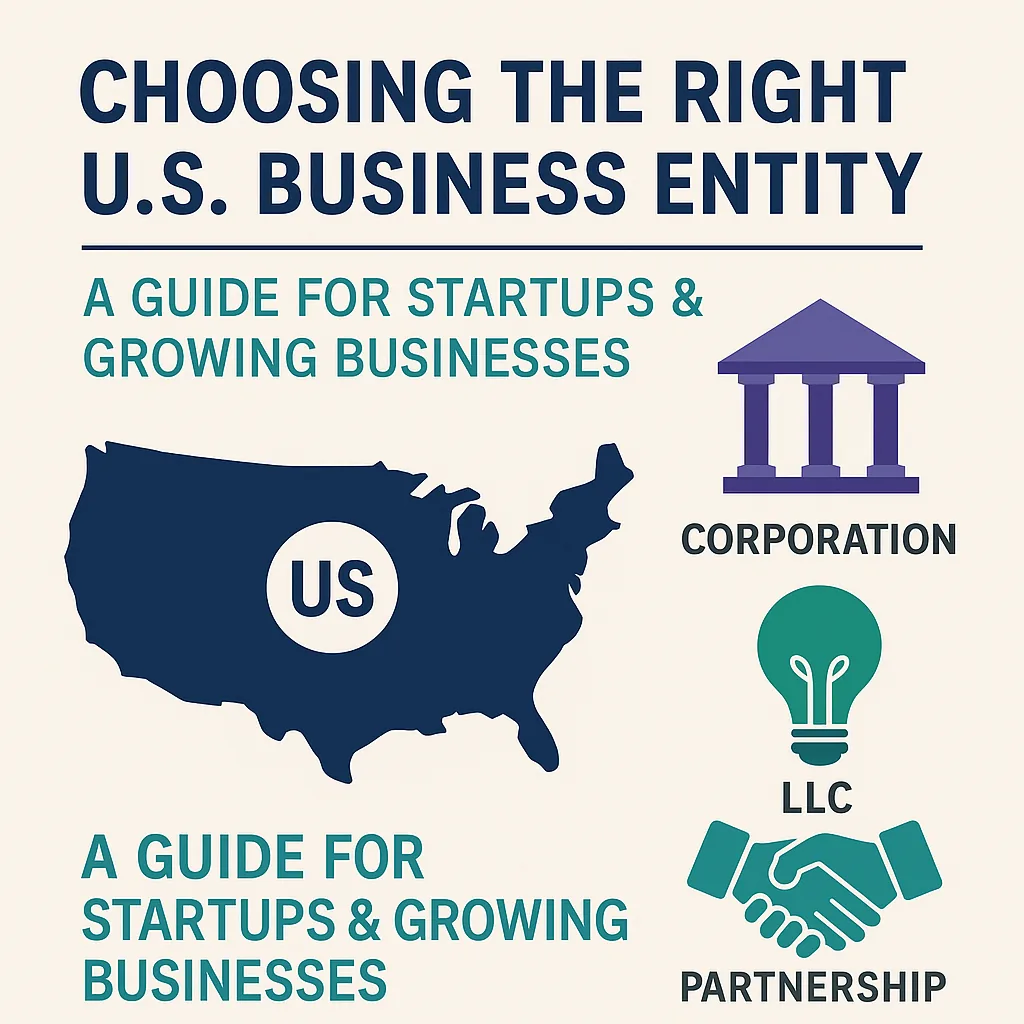
Whether you’re a U.S.-based startup, small business, or an international company entering the U.S. market, understanding available business entities is essential for long-term success.
Below is an overview of the most commonly used structures in the United States.
✅ Corporations
Corporations are separate legal entities that provide strong liability protection for their owners (shareholders). They are often the preferred structure for growing companies and startups seeking investment.
1️⃣ C-Corporation (C-Corp)
A C-Corporation is the most popular entity for U.S. startups — especially those planning to raise capital from venture capital (VC) or private equity investors.
Unlimited shareholders (individuals or entities)
Shareholders pay tax on dividends (double taxation)
Best For: Startups seeking investment, companies planning to scale, or businesses reinvesting profits.
2️⃣ S-Corporation (S-Corp)
An S-Corporation offers pass-through taxation, meaning profits flow directly to shareholders without entity-level tax.
No corporate-level tax (pass-through)
Shareholders must be U.S. citizens or permanent residents
Cannot have more than 100 shareholders
Cannot have corporate or foreign shareholders
Best For: Small U.S.-based businesses looking for pass-through taxation and liability protection.
✅ Limited Liability Company (LLC)
A Limited Liability Company (LLC) blends the simplicity of a partnership with the liability protection of a corporation.
Limited liability for owners (members)
Can be owned by individuals or entities, domestic or foreign
Best For: Startups, small businesses, and service providers that want flexibility and reduced administrative complexity.
✅ Partnership Structures
Partnerships involve two or more individuals or entities conducting business together.
1️⃣ General Partnership (GP)
All partners share responsibility and unlimited liability. Rarely used because of the risk.
2️⃣ Limited Partnership (LP)
General partners — manage the business; unlimited liability
Limited partners — investors; liability limited to their contribution
Best For: Investment-driven structures where some partners are passive.
✅ Branch Office
A branch office is an extension of an existing company operating in the U.S.It is rarely used due to greater exposure.
Parent company is liable for U.S. activities
Best For: Very limited scope or short-term operations (not ideal for startups).
✅ Subsidiary
A subsidiary is a U.S. entity owned by another company. It is usually formed as an LLC or C-Corp.
Best For: Companies establishing a permanent U.S. presence.
✅ Licensing
Licensing allows a business to permit another entity to use its:
The licensee operates the business while paying royalties.
Best For:Companies wanting to monetize their IP without operational involvement.
✅ Franchising
Franchising allows entrepreneurs to replicate a proven business model using a shared brand and operational processes.
Franchisees operate individual locations
Best For: Consumer-facing businesses like retail, food & beverage, and services.
Key Considerations When Choosing an Entity
✅ Taxation (federal + state)✅ Personal liability protection✅ Ease of formation & compliance✅ Ownership structure✅ Capital & fundraising goals✅ Profit repatriation, if applicable✅ Long-term expansion plans
Each entity type offers different benefits, so consulting a professional adviser is recommended.
Conclusion
Choosing the right U.S. business entity is an important early step when launching operations. For most startups, LLCs and C-Corporations are the most commonly selected due to their flexibility and liability protection.
If your goal is to scale or raise venture capital, a C-Corporation is typically the preferred choice. If you want operational simplicity, pass-through taxation, and flexibility, an LLC may be more appropriate.
Whether you are a new entrepreneur or an established business entering the U.S. market, selecting the right structure lays the foundation for compliance, tax efficiency, and long-term success.
📩 Need Help Choosing the Right Entity?
Our experts can help you compare options, plan for tax efficiency, and navigate compliance requirements.